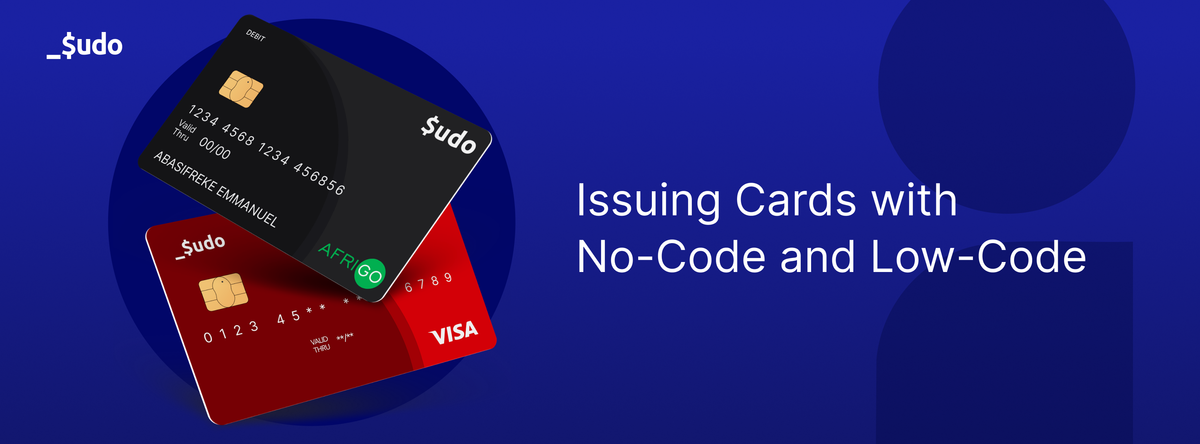
Issuing Cards with No-Code and Low-Code
The Sudo Dashboard is designed specifically for founders and teams who want to launch quickly without writing code

Introduction: Why Coding Matters and How Sudo Simplifies It
At its core, coding is the process of giving instructions to computers so they can perform specific tasks. In fintech, those tasks include creating users, creating and managing local and international virtual bank accounts, money transfer, issuing cards, managing transactions, and enforcing security rules.
Traditionally, building these systems required extensive engineering work, but Sudo changed that narrative by making fintech infrastructure accessible through both no-code and low-code options.
Many founders exploring Sudo offers often wonder how technical they need to be to launch successfully. Some assume they must hire engineers immediately, while others fear limited flexibility if they don’t code. With Sudo’s infrastructure, neither concern has to slow you down.
In the race to launch financial products, speed is everything, and Sudo is built for this reality. Instead of forcing teams to choose between speed and control, Sudo offers a no-code dashboard for fast execution and a low-code API for deeper customization, all within the same ecosystem.
By supporting both approaches, Sudo empowers founders and teams at every stage, from idea validation to large-scale automation, making it easier to build, test, and grow fintech products without unnecessary friction.
The No-Code Route: The Sudo Dashboard
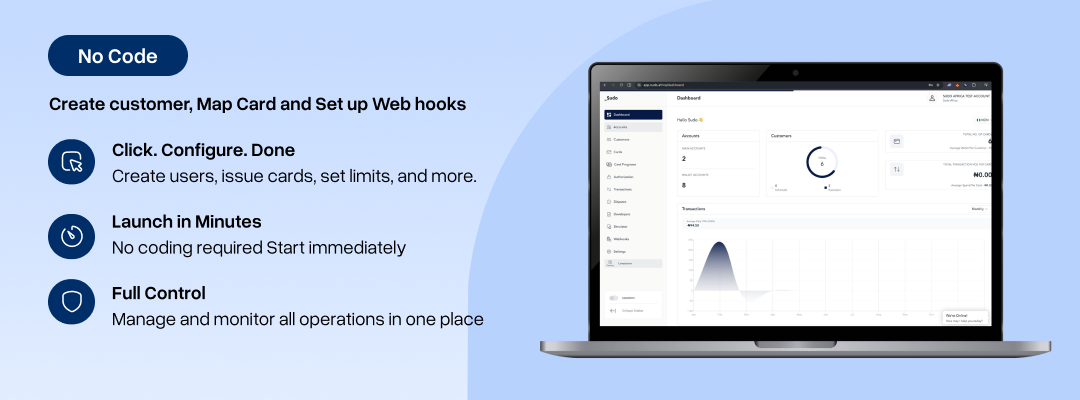
The Sudo Dashboard is designed specifically for founders and teams who want to launch quickly without writing code. Powered by Sudo’s core infrastructure, the dashboard acts as a full operational command center rather than a simple monitoring tool.
Through the Sudo Dashboard (app.sudo.africa), users can experience the full lifecycle of a fintech product directly on Sudo. This includes setting up card programs, issuing cards, and managing security configurations all without touching a backend system.
With the Sudo dashboard, you can configure card programs such as a Virtual AfriGo Credit Card, create cardholders, and instantly issue physical or virtual cards using the dashboard. Most importantly, the dashboard allows teams to define clear usage controls, deciding where a card can be used, when it can be active, and how it can spend. From restricting merchant categories to applying spending limits and usage rules, Sudo enables precise control over card behavior, helping businesses manage risk, enforce policies, and deliver a safer, more intentional payment experience.
For early-stage founders, internal finance teams, or non-technical operators, Sudo’s No-Code Dashboard offers the fastest path from idea to execution, allowing teams to validate concepts and test real workflows in minutes.
The Low-Code Route: Sudo API Integration
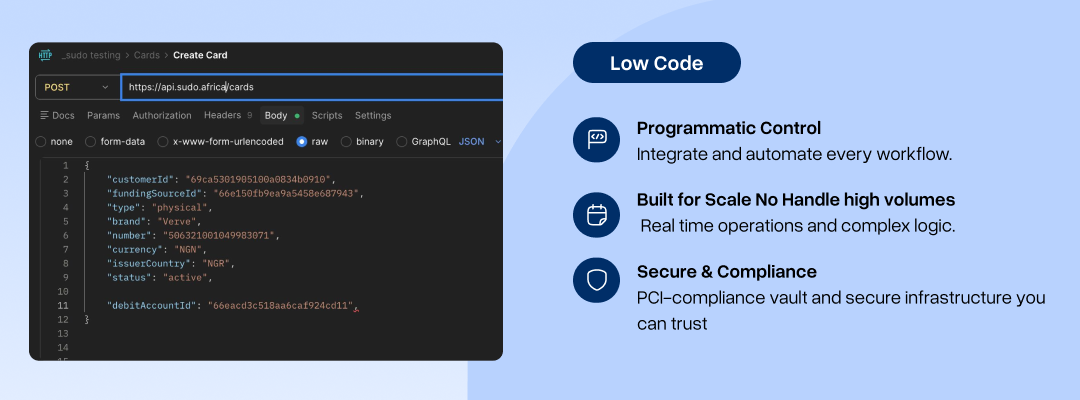
As products grow and user demand increases, the Sudo API becomes the backbone of automation and scale. The Sudo API allows applications to communicate directly with Sudo programmatically, transforming manual processes into seamless background operations.
Using the Sudo API, developers can automate customer onboarding by triggering endpoints and ensuring that every new user is created instantly within Sudo and this makes the Sudo API essential for automation, turning what would normally be manual processes into seamless background operations. Through the API, teams can automatically onboard users, apply detailed spending rules, control where cards can be used, and restrict specific merchant categories, all without human intervention. To ensure security and regulatory compliance, Sudo also provides a secure vault that safely manages sensitive card data, allowing businesses to remain PCI-compliant while relying on Sudo’s trusted infrastructure.
For consumer-facing apps, wallets, and neobanks, the Sudo API is essential for building scalable, always-on fintech products that can support growth without operational bottlenecks.
Choosing Between Sudo No-Code and Low-Code
Choosing between Sudo’s No-Code Dashboard and the Low-Code API depends largely on your current needs and long-term goals. Sudo is intentionally built to support both approaches, ensuring teams never feel restricted by their initial choice.
If your focus is speed and simplicity, the Sudo Dashboard allows you to launch immediately. With the Sudo dashboard, you can manage cards, users, and security manually while gaining a clear understanding of how your product functions. This makes the dashboard ideal for testing ideas, running internal tools, and validating workflows before scaling.
As your product evolves, the Sudo API provides the automation and flexibility needed for growth. By integrating directly with Sudo, teams can replace manual actions with programmatic flows, enabling higher transaction volumes, real-time card issuance, and deeper customization.
What truly sets Sudo apart is the ability to combine both approaches seamlessly. Many teams start with the Sudo Dashboard to explore features, simulate transactions, and understand processes. Once confident, they extend the same workflows using the Sudo API—without switching platforms or rebuilding infrastructure.
Ultimately, Sudo removes the traditional trade-off between speed and scalability. You can launch quickly with no code, then scale confidently with low code, all while staying within the Sudo ecosystem.
Build Faster, Launch Smarter with Sudo
Whether you’re validating an idea or scaling a full fintech product, Sudo gives you the tools to build on your terms. From the No-Code Dashboard to the Low-Code API, Sudo supports every stage of your growth journey.
Ready to start building with Sudo? Sign up now at app.sudo.africa and take the first step toward launching your fintech product faster, smarter, and with confidence.